
Builder Warranty vs. Home Warranty: What's the Difference?
Quick Answer
A builder warranty and a home warranty are not the same thing, and mixing them up can cost you real money. A builder warranty is your builder's obligation to fix defects in workmanship, materials, and structure — broadest in the first year, with some coverage typically extending much longer. A home warranty is a separate, optional service contract you purchase from a third-party company to cover the cost of repairing or replacing major systems and appliances when they break down from normal use. One is about whether the house was built correctly. The other is about routine mechanical failure. Knowing which one applies when something goes wrong saves you a service call fee — or worse, a warranty claim you never should have had to file yourself.
What You'll Learn
- What a builder warranty actually covers, and how coverage typically changes over time
- What a home warranty actually covers — including options many buyers don't know exist
- Why I recommend calling the builder first in year one, even for things their warranty might not cover
- The five-year protection strategy I recommend to my new construction buyers, and when each part is purchased
- Three questions to ask before you assume you're covered
- What to actually do the first time something breaks in a new home
Tim's Take
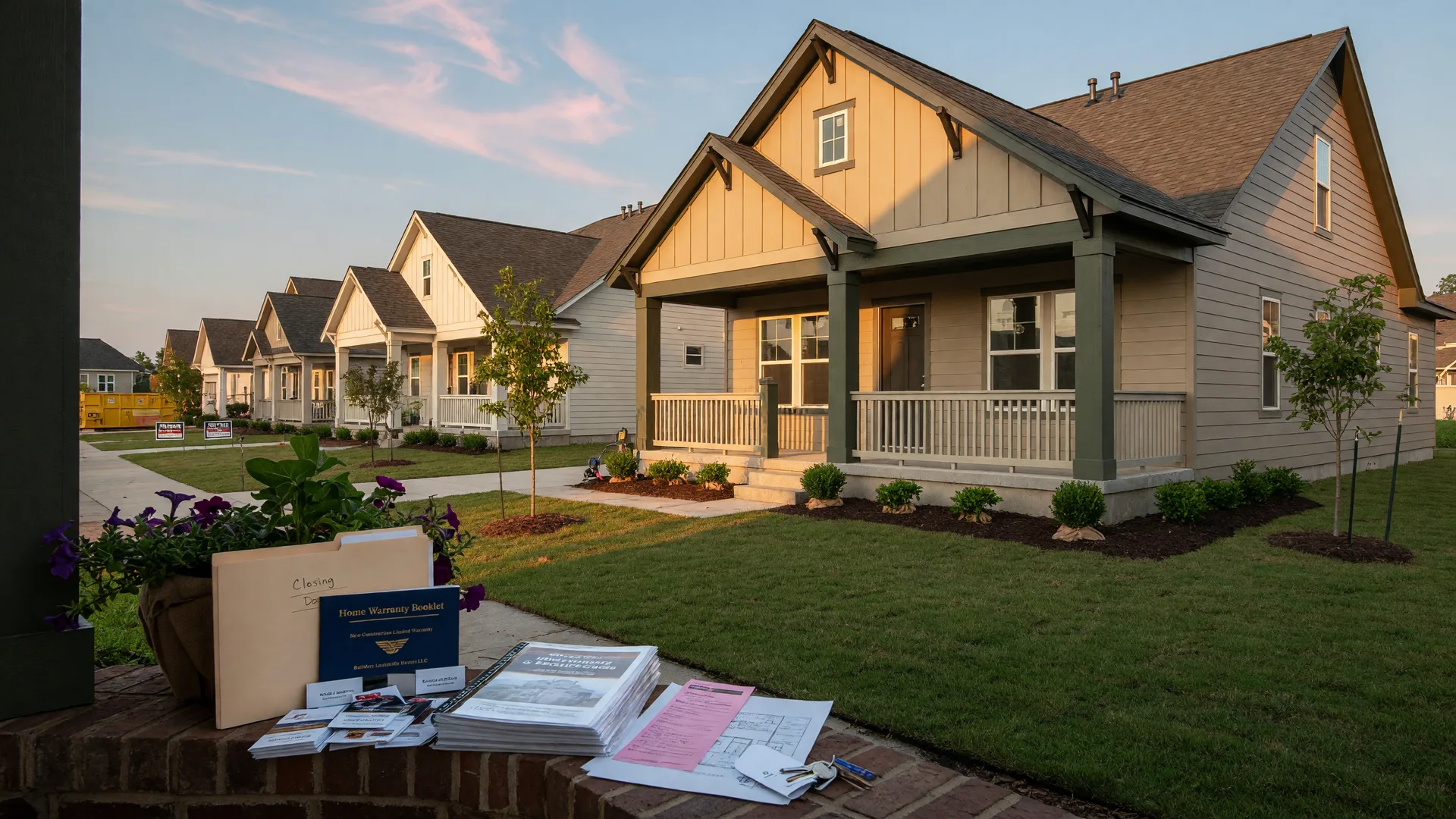
I built homes for years before I ever sold one, and I can tell you the builder warranty vs. home warranty confusion is one of the most common calls I get from new construction buyers — usually right after something stops working. In my experience, most buyers were handed a stack of paperwork at closing, told "here's your warranty information," and never walked through what actually falls under which umbrella. That's not anyone trying to hide the ball — it's just a lot of paper at a stressful moment. This article is the walk-through I wish every new construction buyer got at closing.
What a Builder Warranty Actually Covers
A builder warranty is the builder's contractual promise that the home was built the way it was supposed to be built. As one common example, coverage is sometimes structured in tiers — workmanship coverage around the first year, systems coverage around two years, and structural coverage extending out much longer, often a decade. I want to be careful presenting that as a pattern rather than a rule, though: the exact terms, tiers, and timeframes vary quite a bit from builder to builder, and some builders use a third-party warranty administrator rather than self-warranting. Your specific builder warranty document — not any general example — is what actually governs what's covered, for how long, and under what conditions.
What I can say without hesitation: in my experience, the builder or the builder's designated warranty administrator is the primary resource during that first year. If something comes up related to how the home was constructed, installed, or finished — workmanship, materials, systems, or anything else the builder's warranty is designed to cover — that's normally where I tell my buyers to start.
What a Home Warranty Actually Covers
A home warranty is a completely different animal. It's a service contract — usually paid annually — that you (or sometimes the seller, as a closing gift or incentive) purchase from a third-party company, separate from the builder entirely. Instead of covering construction defects, it covers the cost of repairing or replacing major systems and appliances when they fail from normal wear and tear: things like your HVAC system, water heater, dishwasher, or garage door opener.
A few things I've seen catch new construction buyers off guard, in both directions:
- Home warranties typically charge a service fee (often called a trade call fee) every time you use them — even for something small.
- Most standard plans don't cover code violations, but some warranty companies offer it as an optional add-on. If bringing something up to current code could ever be part of a repair, it's worth asking specifically whether that option is available on your plan.
- Many plans also offer optional coverage for things that fall outside a typical base plan — swimming pools, hot tubs, additional refrigeration units, septic systems, and similar equipment. If you have any of those, it's worth checking whether they're covered automatically or need to be added.
Why I Recommend Calling the Builder First in Year One
During that first year, my general advice is simple: start with the builder or its warranty administrator for almost anything that could reasonably relate to construction, installation, or workmanship. Part of this is that coverage tends to be broadest in year one. But in my experience, there's a practical reason too: builders commonly work through their own warranty process and their own subcontractors to resolve issues, even in cases where it isn't entirely clear upfront whether something is technically covered. Going through the builder first often gets you to the right subcontractor faster than tracking one down yourself.
How well this actually works varies from builder to builder — some are diligent about following through on warranty service, others less so. That variation is a big part of why I like to be involved in the builder selection process in the first place. Not every builder handles post-closing support the same way, and that's worth evaluating before you're under contract, not after something breaks.
The Five-Year Protection Strategy I Recommend
When I work with new construction buyers, my recommendation follows a specific sequence:
Year one — the builder's warranty. This is the broad, first-line coverage for issues arising from how the home was actually built — construction, installation, workmanship, materials, systems, and finishes, as defined by your specific builder's warranty.
Years two through five — third-party home warranty coverage. I generally recommend my buyers purchase a four-year third-party home warranty at closing, structured to begin after the builder's first-year warranty period ends and run for four additional years — creating a five-year protection strategy overall: one year under the builder, four years under the third-party coverage. The specific effective date, term length, covered items, exclusions, and optional coverages vary by product, so it's worth confirming these details on the actual plan you're purchasing rather than assuming they all work identically.
Any longer-duration builder coverage that's still in force after year one — applicable structural or systems terms, for example — simply continues independently according to your specific builder's warranty. It isn't replaced by the home warranty; the two run on their own separate timelines, covering different kinds of risk.
When something comes up during that five-year stretch, I work directly with my buyers to sort out whether it's a builder call or a home warranty call, so they're not left guessing. And since many home warranty plans let you add coverage for things like a pool, hot tub, extra refrigeration equipment, or a septic system, it's worth reviewing what you actually own against what a specific plan covers before assuming something is or isn't included.
By the time that five-year window is up, most homeowners know their house inside and out — what's held up well, what's needed attention — and they're in a much better position to decide whether to keep renewing home warranty coverage annually or handle things on their own from there.
Three Questions to Ask Before You Assume You're Covered
Whenever something goes wrong in a new home, I tell people to slow down and apply the same test I use for almost every real estate decision: don't assume, ask for the evidence.
- What does this actually cover? Pull the specific document — builder warranty booklet or home warranty contract — and read the relevant section, not just the cover page.
- How long does this coverage last? Builder warranty tiers and home warranty terms run on different clocks. Know which clock you're on.
- Who is actually responsible for fixing this? The builder, a subcontractor, or the home warranty company can each be the right answer depending on the cause and the timing — not just the symptom.
What To Do When Something Breaks
During the first year, start with the builder for almost everything that could plausibly relate to construction, installation, or workmanship — even if you're not sure it's technically covered, since builders commonly handle this kind of issue through their own warranty process and subcontractors. Document the issue with photos, dates, and a written description, and submit it through whatever claims process your builder specifies. Once you're into year two and beyond, the third-party home warranty coverage you purchased at closing takes over as the next call for ordinary mechanical breakdowns. Keeping good records from day one makes every one of these processes faster.
Frequently Asked Questions
When should I buy the third-party home warranty, and when does it start?
I generally recommend purchasing it at closing, structured to begin once the builder's first-year warranty period ends and run for four additional years — a protection strategy across the first five years using two different types of coverage. Confirm the actual effective date and term on the specific product you're buying, since this can vary by provider and plan.
Do I need a home warranty if I already have a builder warranty?
That's a personal decision, but I generally recommend it to my new construction buyers. In year one, the builder's warranty is your primary protection. In years two through five, the third-party home warranty I recommend purchasing at closing carries that protection forward for ordinary mechanical breakdowns — a genuinely different risk than what the builder's warranty is designed to cover.
Does a builder warranty cover appliances?
Usually not directly — appliances typically come with their own manufacturer warranties, separate from both the builder warranty and any home warranty. Worth keeping that paperwork too.
Can a home warranty cover things like a pool or septic system?
Often, yes, as an optional add-on rather than something included automatically in a base plan. If you have equipment like that, ask specifically what it would take to add it.
Does a home warranty cover bringing something up to code?
Not always, but some companies offer it as an optional add-on. Worth asking about directly if it matters to you, since it's not standard on every plan.
What happens if my builder goes out of business during the warranty period?
This varies significantly depending on whether your builder self-warrants or uses a third-party warranty administrator, and on state-specific rules — worth asking your builder directly which structure applies before you're relying on it.
Bottom Line
A builder warranty and a home warranty cover different risks, and the strategy I recommend treats them as sequential rather than overlapping: one year of broad builder protection, followed by a four-year third-party home warranty purchased at closing — protection across the first five years from two different types of coverage. Know what's covered, for how long, and by whom, and you'll spend a lot less time guessing when something actually breaks.
If you're planning to build a new home in Louisville, I'd like the opportunity to represent you — from helping you evaluate builders before you ever sign a contract, to helping you understand the builder's warranty process and identify questions worth asking about the warranty terms, to helping you sort out who's responsible when something comes up down the road.
Call 502-429-3866.
— Tim
About Tim Hollinden
Tim Hollinden is a former home builder and Broker Associate with The Hollinden Team at eXp Realty. For more than 24 years, he has completed over 1,650 real estate transactions throughout Greater Louisville by combining builder knowledge with practical, evidence-based real estate advice.