Custom vs. Production Builders in Louisville
Quick Answer
Neither a custom builder nor a production builder is inherently the "better" choice: they're built for different priorities, and the right one depends on what actually matters most to you: personalization and control, cost and price predictability, timeline, location and lot flexibility, and how much decision-making you want to take on during the build. The mistake I see most often isn't picking the wrong builder type. It's picking one based on how it feels in the moment, rather than what it actually requires of you.
What You'll Learn
- The real structural differences between custom and production builders
- Where "semi-custom" fits, and why the label alone doesn't tell you much
- How to apply Strategy over Emotion to this decision instead of choosing based on a model home
- Questions worth asking before you commit to either path
Tim's Take
I built both custom and spec homes for years, so I've sat on the builder's side of this decision as often as the buyer's side. What I've noticed is that people often fall in love with the idea of custom, the appeal of designing something entirely their own, without weighing what that actually costs them in time, decisions, and price certainty. Others default to a production builder because it feels simpler, without realizing how little room that may leave for changing their mind later. Neither instinct is wrong. But neither should be the deciding factor by itself.
Why the Common Assumption Is Wrong
Most buyers assume the choice comes down to budget alone: custom costs more, production costs less. In practice, the bigger difference is usually structural: how much control you have over the design, how much of that control comes with added decisions and variables, and how much price predictability you're giving up in exchange for it. Price is part of it, but it's rarely the whole story.
The Real Differences
What You're Actually Building
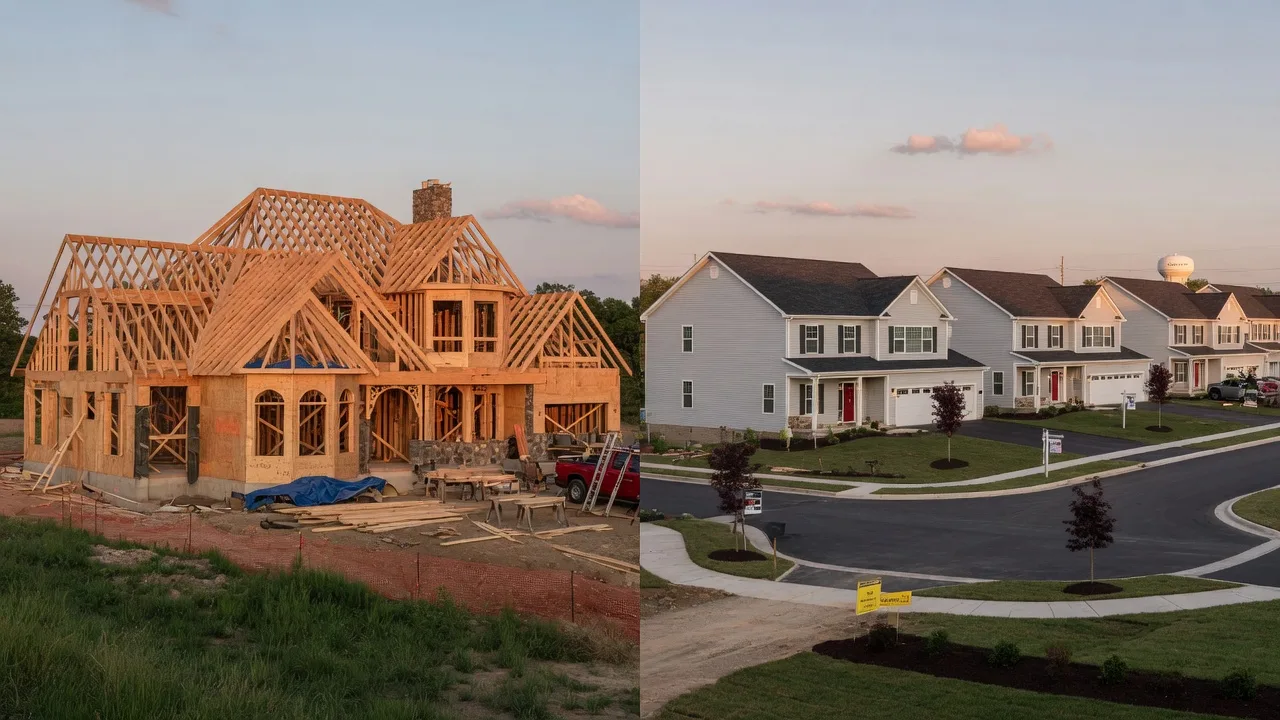
A production builder typically works from a limited set of pre-designed floor plans, often within a specific subdivision, on a lot the builder already controls. A custom builder typically builds to a design that's unique to you, sometimes an architect-designed plan, sometimes a heavily modified version of a base plan, often on a lot you already own or have selected yourself. That distinction (whose lot, whose plan) tends to drive most of the other differences below.
Cost and Price Predictability
Production builders generally offer earlier and greater price predictability, since the plan, materials, and process are largely standardized before you ever sign: fewer variables usually means a number you can trust earlier in the process. Custom building generally introduces more variables: a unique design, more individual selections, site-specific conditions, and less standardization overall, all of which create more room for the price to move as decisions get made, and which often push costs higher as a category, even though an expensive production home can certainly cost more than a modest custom one. The honest distinction isn't which approach costs more; it's which approach gives you a reliable number sooner.
Timeline
Production builds are often faster, since the plan and processes are repeatable across many homes. Custom builds may take longer, particularly if they involve architectural design work, permitting for a unique structure, or a lot that requires more site preparation. If your timeline is a hard constraint, it's worth asking any builder directly for a realistic range based on their current schedule, not just their advertised estimate.
How Much Flexibility You Have to Customize and Change Things
Production building is generally more constrained by design: standardization is part of the model, so the plans, materials, and process tend to be fixed earlier, with less room to deviate once you've selected a floor plan. Custom building generally offers more flexibility to shape the design and specifications to what you actually want. But the specific boundaries, what can be changed, when, and at what cost, vary by builder and by contract in both categories. A production builder may allow more selection flexibility than you'd expect; a custom builder's contract may be more standardized and less flexible than the label suggests. Establish the actual boundaries with any builder you're considering before you assume either label tells you how much say you'll have.
"Semi-Custom" and Why the Label Alone Isn't Enough
Many builders describe themselves as "semi-custom," which can mean genuinely different things from one builder to the next: sometimes a base plan with a meaningful list of structural options, sometimes just a few finish-level choices layered onto a production process. The label itself doesn't tell you much. Ask specifically what can and can't be changed before you assume a "semi-custom" builder gives you more flexibility than a production builder would.
Applying Strategy Over Emotion to This Decision
It's easy to choose based on how a model home makes you feel, or how appealing the word "custom" sounds, rather than what the choice actually requires of you. The pattern underneath all of this is fairly consistent: more control usually comes with more decisions, more variables, and less price predictability, while more standardization usually means more predictability but less control. Before deciding, it's worth being honest with yourself about a few things:
- How much control over design and specifications do I actually want, versus how much decision-making am I willing to take on to get it?
- How much does early price predictability matter to me versus flexibility to shape the design along the way?
- Do I already own or have a specific lot in mind, or am I open to building within a builder-controlled community?
- How firm is my timeline, and what happens if it slips?
There's no universally right answer to any of these: only the answer that's actually true for your situation, rather than the one that feels most exciting in a sales office.
Frequently Asked Questions
Is a custom home always more expensive than a production home?
Not always: it depends heavily on the size, finishes, and design you choose in either case, and an expensive production home can certainly cost more than a modest custom one. But as a category, custom construction typically involves more individual decisions, more site-specific variables, and less standardization, which often pushes costs higher and makes the final number less predictable early on. Production building generally offers more price predictability sooner, precisely because there's less to vary.
Can I customize more with a custom builder?
Generally, yes, in the sense that custom building is built around individualized design and specification choices, while production building is built around a standardized, repeatable process. But how much flexibility you actually get, and how much room there is to negotiate the contract itself, varies by builder and by contract in both categories. Don't assume a specific level of flexibility from the custom or production label alone; ask any builder directly what can and can't be changed before you sign.
Do production builders build on land I already own?
Usually not: production builders typically build within their own subdivisions, on lots they control. If you already own a lot, a custom or semi-custom builder is more likely to be able to work with it, though it's worth confirming directly.
How much longer does a custom build typically take?
It varies significantly depending on design complexity, permitting, and the specific builder's process, so there's no single reliable estimate here. Ask any builder you're considering for a realistic timeline range based on a design similar to what you're planning.
Bottom Line
The right builder type depends on what you're actually optimizing for: control over personalization, cost and price predictability, timeline, location and lot flexibility, and how much decision-making you want to take on, not on which option feels more appealing in the moment. Get honest with yourself about your real priorities first, then let that guide which type of builder, and which builder, makes sense for you.
If you're still deciding between a custom and production builder in Louisville, and haven't engaged your own agent yet, I can help you think through which approach actually fits your priorities, from someone who's built both.
If you'd like to talk before you commit to a builder or a lot, call 502-429-3866.
— Tim
About Tim Hollinden
Tim Hollinden is a former home builder and Broker Associate with The Hollinden Team at eXp Realty. For more than 24 years, he has completed over 1,650 real estate transactions throughout Greater Louisville by combining builder knowledge with practical, evidence-based real estate advice.