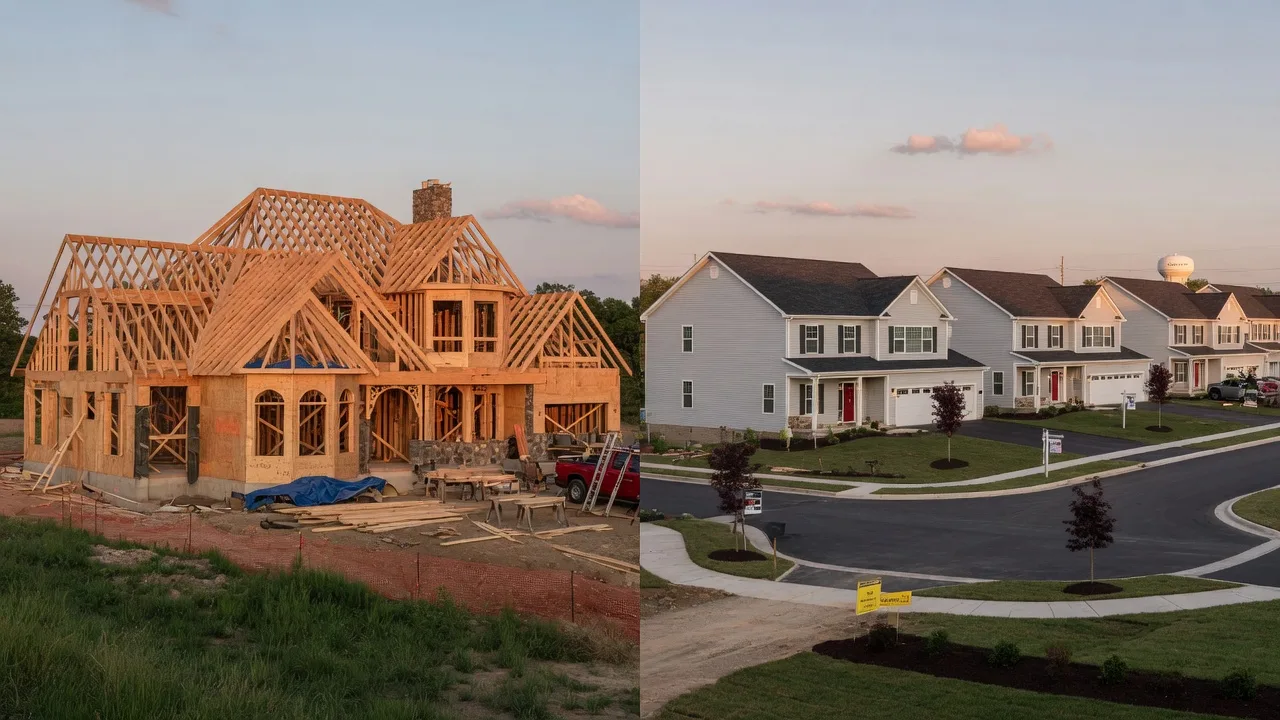

Should I Build or Buy a Home in Louisville?
By Tim Hollinden, Broker Associate | The Hollinden Team at eXp Realty
Quick Answer
There's no universally right answer -- but there is a wrong way to decide. Most people make this decision based on which option feels more exciting, not which one actually fits their timeline, their budget tolerance, and how much control they really want over the process. Get those three things straight first, and the answer usually becomes obvious.
What You'll Learn
- Why "I want it built exactly my way" isn't reason enough on its own
- The real cost difference between building and buying -- and why the comparison isn't as simple as it looks
- What's actually known about construction timelines nationally, and why local timelines vary so much
- How builder financing works, and why it varies more than most buyers expect
- The four questions that actually decide this, not personality or preference
- Where builder contracts complicate things buyers don't expect
Tim's Take
I've been on both sides of this decision -- literally. Before I sold real estate, I built custom and spec homes across Jefferson County, Oldham County, and Southern Indiana for years. I know what a house actually costs to build, where the delays hide, and what a builder is really thinking during a negotiation. Over the years I've learned that most people who ask "should I build or buy" are really asking a different question underneath it -- usually something closer to "will I regret not building it exactly the way I want," or "can I actually afford to wait." Once we get to that real question, the decision tends to sort itself out.
Here's the way I actually think about it: you're not choosing between two houses. You're choosing between two different sets of constraints. An existing home generally gives you more certainty -- you know the location, the finished product, the price, and roughly when you'll move in -- but less control over what the home actually is. Building generally gives you more control over the finished product, but within the limits of what land, builders, and time will allow, and usually with less certainty about the final number. Neither set of constraints is better. They're just different, and knowing which one you can live with is most of the decision.
Why "I Want It My Way" Isn't the Whole Answer
Building has one obvious appeal: you get to choose everything. New cabinets, your own floor plan, no one else's paint color choices to undo. That's real, and for some buyers it's worth a lot.
But here's what I've seen happen -- people commit to building because they want control, and then discover that control comes with a second full-time job. Selecting finishes, meeting with the builder, reviewing change orders, tracking a schedule that shifts more often than anyone expects. Buying an existing home hands you a finished product with a known price and a known move-in date. Building trades some of that certainty for choice. Both are legitimate trades. The mistake is choosing without weighing what you're actually trading away.
That trade-off is really what the next four questions are about.
Question 1: What Will Each Option Really Cost?
One of the most common assumptions I run into is that building costs less than buying, since you're not paying someone else's markup. What I've found is that buyers are often surprised building isn't cheaper once everything is counted -- lot cost, site prep, selections and allowances, upgrades that seemed small individually but add up, and the almost-universal habit of upgrading finishes once you're already committed to the process.
With an existing home, you generally establish the negotiated purchase price at the beginning of the transaction, which gives you considerably more cost certainty. With a build, the final number can be less predictable, depending on the builder, the contract, your selections, the allowances built into the price, and whatever changes get made along the way. That's not a reason to avoid building. It's a reason to evaluate the total realistic cost -- including a genuine contingency -- rather than comparing your existing-home search against a builder's base price alone. Which option actually costs less depends on the specific property, the land, the builder, and what's available in the resale market at the time -- not a rule that runs one direction every time.
Question 2: How Much Flexibility Do I Have in My Timeline?
Nationally, single-family homes built for sale in new-construction communities are currently taking roughly 7 to 8 months from permit to completion, while custom, owner-directed builds are running closer to 14 to 15 months, according to the most recent Census Bureau Survey of Construction data compiled by the National Association of Home Builders.
Those are national averages, and I'd be careful about assuming they translate directly to any one Louisville build. Locally, what I've seen is that timelines vary a lot -- by builder, by how ready the lot is, by the local permitting process, and by how quickly (or slowly) selections and decisions get made along the way. The honest answer is: ask your specific builder for their track record, not a national number or a neighbor's experience, before you count on a date.
If your timeline is flexible, that's simply a fact to plan around. If you need to be in a home by a specific date -- a school year, a job start date, a lease ending -- that timeline is often the single biggest factor in this decision, more than cost and more than finishes.
Question 3: How Much Control Do I Actually Need?
This is where the decision usually actually lives. Ask yourself honestly: is there something specific about an existing home you can't get any other way -- a floor plan, a lot, a finish level -- or is it more that you like the idea of everything being new? Those are different answers. Plenty of resale homes can be renovated to get most of what a buyer wants from building, often faster and for less than a full custom build. Building makes the most sense when there's something concrete you're solving for that renovation genuinely can't fix.
Question 4: Can I Build What I Want, Where I Want It?
Depending on where you want to live in the Louisville area, buildable lots in established neighborhoods can be limited, and available new-construction communities are concentrated in specific parts of Jefferson, Oldham, and the surrounding counties. If the location matters as much to you as the home itself, that alone can settle the decision -- the right lot in the right spot may simply not exist as a build option right now, or may only exist through a production builder's community rather than a fully custom build. Sometimes this question resolves the other three before you even get to them.
A Second Set of Experienced Eyes During Your Build
One thing I do differently that most buyers don't expect from a real estate agent: I stay involved during the actual construction, not just at contract signing and closing. Because I spent years building homes myself, I know what to look for at each stage -- framing, rough-in, before drywall goes up and covers everything behind it. I'm not there to replace your home inspector, your municipal inspections, or an engineer where one's needed; those still matter, and I always recommend them. What I bring is another experienced set of eyes throughout the process -- someone who can notice something worth questioning while it's still visible, and raise it while there's still time to ask the builder about it.
Two Things That Complicate Building Most Buyers Don't See Coming
Builder contracts are written differently than a standard real estate purchase contract -- they protect the builder's timeline and cost structure in ways a typical buyer doesn't expect, and they deserve their own careful read before signing (I go through what's actually in one, and the questions worth asking before you sign, in Understanding Builder Contracts in Louisville).
Construction financing also works differently than a traditional mortgage, and it varies more by builder than most buyers expect. Some established custom builders finance the construction themselves as part of their business model -- the buyer makes the required deposit or down payment upfront, then doesn't obtain permanent financing until the home is complete. Other builders don't offer that, and require progress payments at set stages throughout construction, which means the buyer is managing a construction loan themselves along the way. And with larger production builders, it's worth looking past the price tag alone -- many offer financing incentives that can make the effective monthly payment, or the total cost over the life of the loan, lower than a higher-priced home might suggest at first glance. None of this is something to sort out after you've already chosen a lot or a floor plan -- it's worth understanding which model a builder uses before you're deep into the decision (I cover this in more detail in Construction Loans Explained).
Frequently Asked Questions
Is it always cheaper to buy an existing home than to build one?
Not always, but buyers are frequently surprised that building isn't cheaper once lot cost, selections, upgrades, and a realistic contingency are counted. Which option actually costs less depends on the specific property, the land, the builder, and the local resale market -- not a fixed rule.
How much control do I actually get if I buy from a production builder instead of building fully custom?
More than people expect, and less than a fully custom build. Production builders typically offer a set list of floor plans and finish packages you choose from, rather than a blank slate -- a middle path worth understanding before ruling either option out (more on this in a future article).
Can I get most of what I want from an existing home through renovation instead?
Often, yes -- and it's usually faster and less expensive than a full build. It depends on whether what you want is achievable within the home's existing structure or requires starting over.
Does my builder background actually help buyers who choose to build?
It does, mainly in negotiation and in staying alert to potential issues while the home is under construction -- while your inspector and the municipal inspections still do their job, I'm walking the site with the experience to notice when something is worth a question.
Why do some builders require a construction loan and others don't?
It comes down to how the builder finances their own operations. Some finance construction themselves and only collect the remainder at closing; others need progress payments along the way and expect the buyer to carry a construction loan. It's worth asking directly before you sign anything.
Should I get pre-approved differently if I'm considering building versus buying?
Yes -- construction financing works differently than a standard mortgage, and it's worth having that conversation with a lender before you're far into the decision, not after.
Bottom Line
Building and buying aren't really competing against each other -- they're two different sets of constraints, and the right choice depends on which set fits your actual situation. What will each option really cost you, honestly counted? How much flexibility do you have in your timeline? How much control do you actually need over the finished product? And can you build what you want, where you want it? Answer those four questions truthfully, and the decision usually becomes clear on its own.
If you're weighing whether to build or buy in the Louisville area and want to think it through with someone who's actually done both, I'd be happy to walk through your specific situation -- no pressure, no obligation. Call 502-429-3866.
Let's Walk Through Your Situation
Weighing building vs. buying in the Louisville area? I'd be happy to walk through your specific situation -- no pressure, no obligation. Call 502-429-3866 or reach out through the contact page.
Contact Tim
Tim Hollinden
Broker Associate | The Hollinden Team at eXp Realty
☎ 502-429-3866
@ TimHollinden.com
About Tim Hollinden
Tim Hollinden is a former home builder and Broker Associate with The Hollinden Team at eXp Realty. For more than 24 years, he has completed over 1,650 real estate transactions throughout Greater Louisville by combining builder knowledge with practical, evidence-based real estate advice.
-- Tim