Does a Finished Attic Add Value?
By Tim Hollinden, Broker Associate | The Hollinden Team at eXp Realty
Quick Answer
Sometimes -- but an attic conversion is one of the trickiest "value" questions homeowners ask me, because whether it counts toward your home's value at all often comes down to a measurement standard and a local labeling custom most people never think to check. Get those right, and a finished attic can be a genuinely strong investment. Miss one, and you may have spent tens of thousands of dollars on space that doesn't move the number on your appraisal -- or gets listed with an asterisk that buyers notice.
What You'll Learn
- Why building code and "counts as square footage" are two different questions
- The ANSI ceiling-height rule that most often determines whether attic space counts
- How our market specifically handles attic space that doesn't meet ANSI standards
- The Refresh vs. Renovate Test applied to attic spaces
- Type 1 vs. Type 2 thinking for attic conversions
- How to use the Evidence Test before committing to this project
Tim's Take
Over the years I've learned that attic conversions are one of those projects where people conflate two separate questions: "Is this legal and safe to finish?" and "Will this actually count as more square footage?" Building code answers the first question. It doesn't answer the second.
I've walked through beautifully finished attic spaces -- real flooring, drywall, even a mini-split for heating and cooling, fully permitted and code-compliant -- that still don't add a clean square foot to a home's listed size, because the ceiling height doesn't work the way appraisers measure it. The work can be flawless and still not move the number that actually drives value the way the homeowner expected.
Two Different Questions: Code Compliance vs. Counted Square Footage
Building code determines whether the space is legal and safe to finish and occupy -- things like structural load, electrical, and general habitability requirements. This matters on its own; it's not optional, and it's not really a value question so much as a "can I legally do this at all" question.
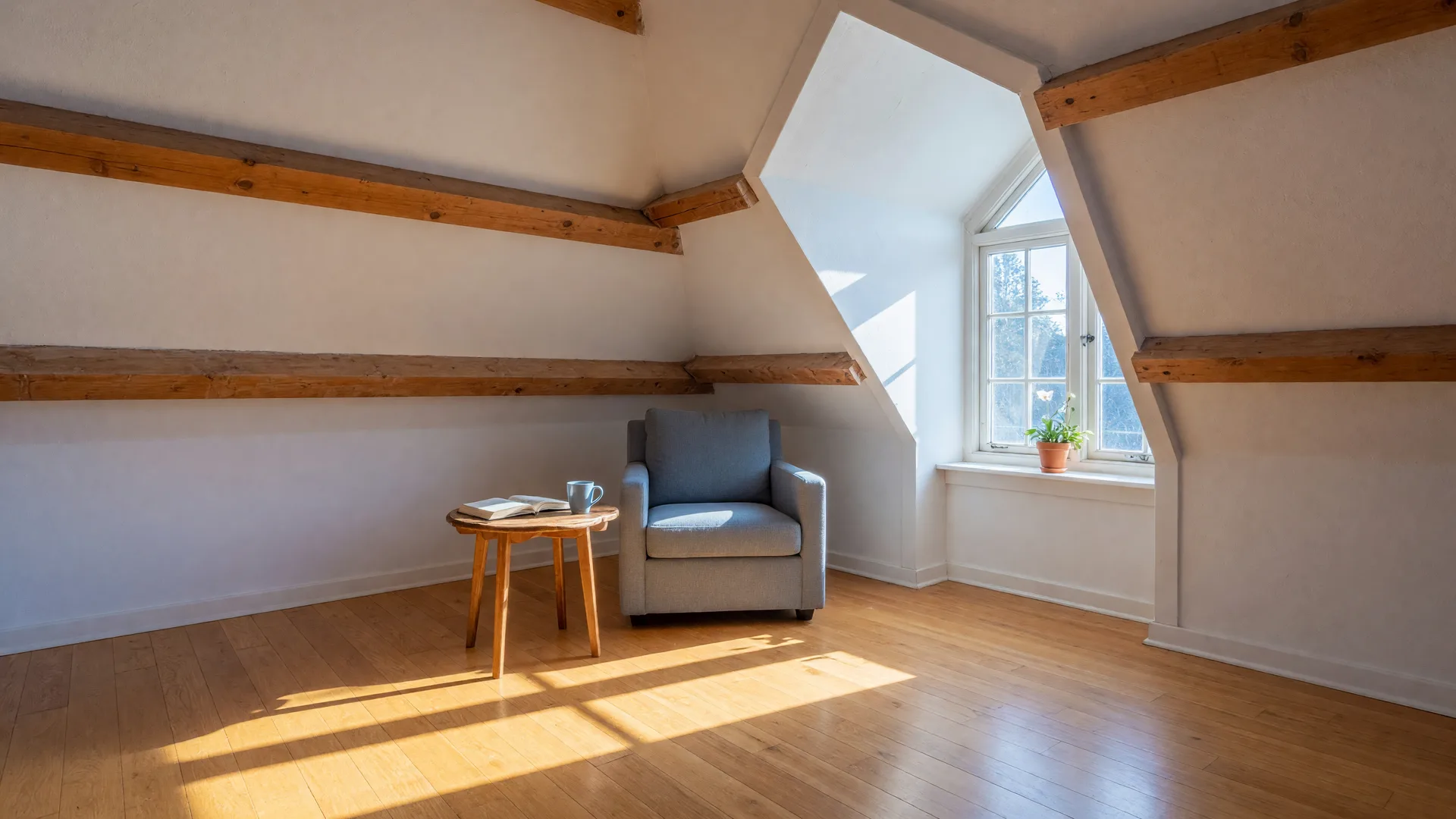
Whether that finished space counts as above-grade finished square footage is a separate determination, and it's the one that actually affects value. Appraisers generally work from the ANSI Z765 measurement standard, and the rule that trips up the most attic conversions is ceiling height: in a room with a sloped ceiling, at least 50% of the finished square footage must have a ceiling height of 7 feet or more, and areas below 5 feet aren't counted at all. A lot of otherwise-beautiful attic conversions simply don't have enough usable headroom to clear that threshold.
Here in our market, if a finished attic doesn't meet that standard, it doesn't necessarily get excluded from a listing altogether. The way we typically handle it locally is to still include it as finished square footage in the MLS listing, but mark it as non-conforming above-grade finished square footage -- a distinction that tells appraisers, agents, and buyers exactly what they're looking at. It's not hidden, and it's not blended in as if it were fully conforming space; it's labeled for what it is.
That label matters. A buyer's lender and appraiser will still weigh non-conforming square footage differently than fully conforming space, so it's worth understanding that distinction before you invest, not after.
The Refresh vs. Renovate Test, Applied Here
Before committing to a full conversion, ask what you're actually trying to solve. If the attic is already used for occasional storage and the real goal is one more flexible room -- a home office, a guest space -- sometimes a lighter refresh accomplishes the goal at a fraction of the cost, without chasing full ANSI-conforming status. A full renovation aimed at conforming square footage only makes sense once you know whether the roofline and existing headroom can actually clear the ceiling-height threshold -- that's worth checking before you spend a dollar on finishes.
This is the same Refresh vs. Renovate framework I apply to any improvement decision. For a deeper walkthrough of when a refresh makes more sense than a full renovation, see my guide on whether to remodel before selling your Louisville home.
Type 1 vs. Type 2 Thinking
An attic conversion is almost always a Type 2 improvement -- one that increases value conditionally, not automatically. It's rarely a Type 1 (inspection or safety) item on its own. That distinction matters because Type 2 improvements only pay off when buyers recognize enough additional utility and value to justify the cost -- and whether the space qualifies as conforming square footage can have a major effect on that calculation.
For a full breakdown of Type 1 versus Type 2 improvements and the distinction between protecting value and trying to add it, see my guide on what repairs to make before selling your Louisville home.
The Evidence Test
Before finishing an attic with resale in mind, I'd want to look at the actual evidence: comparable homes in your neighborhood where finished attic space was counted -- conforming or non-conforming -- in the listed square footage, what those homes actually sold for versus similar homes without it, and what a local appraiser or your agent says about how attic space typically gets measured and labeled in your specific area.
This is the same Evidence Test I apply to every improvement meant to increase value. For the full framework, including the Type 2A/2B breakdown and the Neighborhood Ceiling concept that applies directly to attic conversions, see my guide on which home improvements actually increase value in Louisville.
I apply this same thinking to another space-related improvement question: whether a finished basement adds home value, which raises a similar set of measurement and labeling questions. And the improvement ROI conversation extends to other polarizing features too -- I cover the pool resale value question in a separate article.
Frequently Asked Questions
Does a finished attic count the same as a home addition?
Not usually. Even when fully code-compliant, it typically only counts as fully conforming above-grade finished square footage if it clears the ANSI ceiling-height threshold -- and even then, appraisers and buyers often treat attic space somewhat differently than main-level or true second-floor space.
If my attic is up to code, doesn't that mean it counts as square footage?
Not necessarily -- that's the exact distinction worth understanding before you invest. Code compliance and counted square footage are determined by different standards.
What happens if my attic doesn't meet ANSI standards?
In our market, it can still be included in a listing as finished square footage, but it gets marked as non-conforming above-grade finished square footage. It's still represented -- just labeled accurately, which matters to appraisers and buyers alike.
Is an attic conversion a good investment if I'm not selling soon?
That's a lifestyle question as much as a value question. If you'll use and enjoy the space for years, that's worth something on its own, separate from resale math.
Bottom Line
A finished attic can add real value -- but whether it counts as fully conforming or non-conforming square footage most often comes down to ceiling height under the ANSI standard, not just whether it's built to code. Before I'd recommend a homeowner move forward, I'd want the Evidence Test run against their specific neighborhood, and a clear-eyed look at how the space will actually be labeled once it's done.
If you're weighing an attic conversion and want an honest read on how it's likely to be measured -- and labeled -- in your specific home and neighborhood, I'm happy to talk it through. No pressure, no obligation. Call 502-429-3866.
Related Reading
- Which Home Improvements Actually Increase Value in Louisville? -- The full Evidence Test framework and Type 2A/2B breakdown
- Does a Finished Basement Increase Home Value? -- Similar measurement and below-grade label questions
- Should I Remodel Before Selling My Louisville Home? -- Refresh vs. Renovate decision framework
- What Repairs Should I Make Before Selling My Louisville Home? -- Type 1 vs. Type 2 improvement distinction
- Does a Swimming Pool Increase Home Value? -- Another conditional improvement ROI question
Weighing an Attic Conversion?
I'd be happy to pull the comparable sales for your neighborhood and help you figure out whether the investment makes sense -- no pressure, no obligation. Call 502-429-3866.
Get in TouchCall 502-429-3866
About Tim Hollinden
Tim Hollinden is a former home builder and Broker Associate with The Hollinden Team at eXp Realty, licensed in Kentucky, Indiana, and Alabama. With 24+ years in real estate sales and more than 1,650 real estate transactions, Tim helps buyers and sellers throughout Greater Louisville and Southern Indiana make informed decisions using practical, evidence-based advice. His builder background provides added insight into construction, condition, improvements and value, while nearly two decades as a tech-company CEO shaped the systems-driven marketing he uses today. Tim is also a three-time eXp ICON Agent, an early A.I. Certified Agent™, and holds Zillow's Best of Zillow recognition.
-- Tim