

How Do Multiple Offers Really Work?
By Tim Hollinden, Broker Associate | The Hollinden Team at eXp Realty
Quick Answer
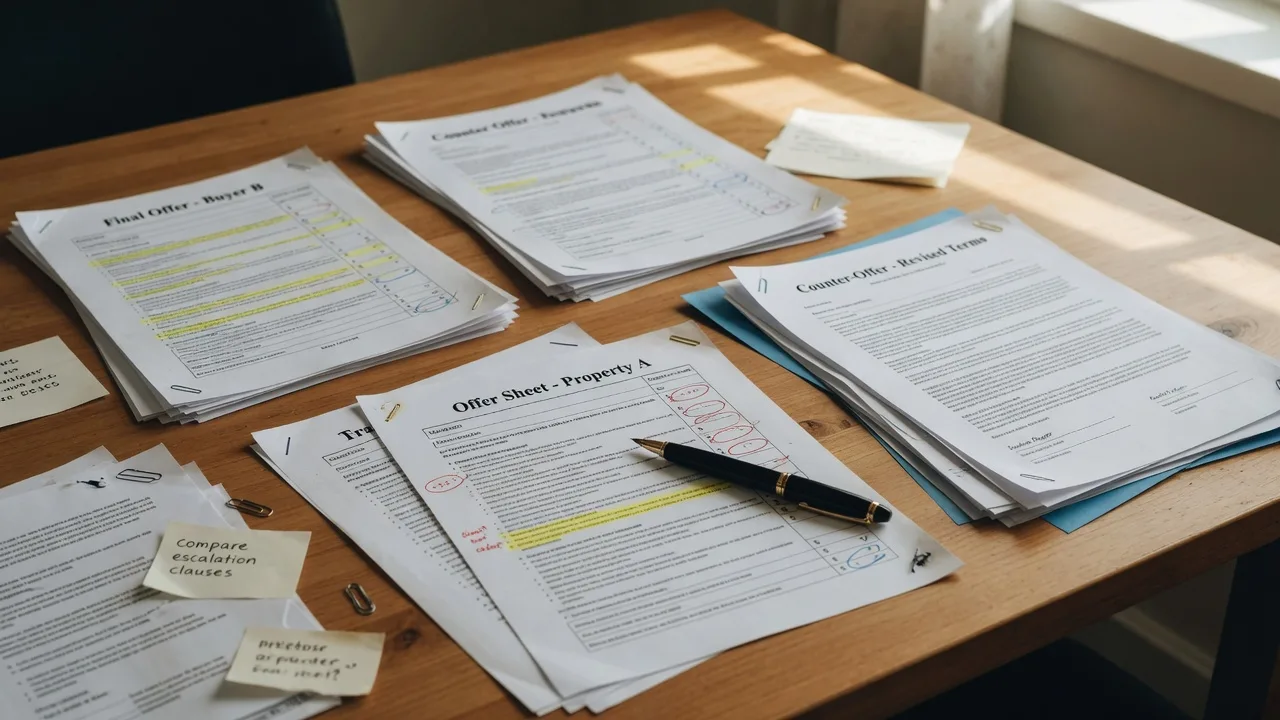
Multiple offers don't automatically mean the highest number wins — and they don't mean you should panic-pick the first one that looks strong either. When more than one offer comes in, you're not just evaluating one offer against the evidence anymore. You're evaluating several offers against the evidence, and against each other, at the same time. That's a different exercise, and it's worth understanding before you're actually in it.
What You'll Learn
- Why "just take the highest offer" is incomplete advice
- What a "highest and best" call actually means — and why I don't always recommend it
- How to compare multiple offers side by side using the same evidence you'd use for one
- Why possession terms deserve just as much weight as price
- What an escalation clause really tells you, and how that information might factor in
- Why speed and pressure are part of the process, not a sign something's wrong
Tim's Take
Multiple offers feel exciting, and I understand why — it feels like validation. But excitement is exactly when sellers stop asking the questions they'd normally ask. I've watched people fixate on the top-line number across three or four offers and miss that the "winning" one had financing that was far shakier than the second-place offer, or a closing timeline that didn't fit their situation at all.
Why "Just Take the Highest Offer" Is Incomplete Advice
The highest number isn't the same thing as the strongest offer. A buyer offering the most money with a shaky pre-approval, a long list of contingencies, or an unrealistic closing date can end up costing you more time and certainty than a slightly lower offer with clean terms and reliable financing. Multiple offers should make you more rigorous about terms, not less.
What "Highest and Best" Actually Means
When several offers come in around the same time, it's common to set a deadline and ask every interested buyer to submit their strongest possible offer by a specific time — this is what's known as a "highest and best" call. It's not a trick, and it's not required. It's simply a way of giving every buyer a fair, equal opportunity to put their best terms forward before you decide, instead of negotiating with one buyer while others wait in the wings.
Should You Always Call Highest and Best?
Not necessarily, and this is one of the first things I talk through with sellers when multiple offers show up. Calling highest and best can work well when several offers are genuinely close and a deadline helps everyone compete fairly. But it can also backfire. Some buyers simply choose not to participate in what feels like a bidding war, and if you already have a strong offer sitting in front of you, forcing every buyer into a competitive deadline can cause that buyer to walk away — not because their offer was weak, but because they didn't want to negotiate that way. I've seen sellers accidentally push away their best offer by treating a good situation like it needed more pressure than it actually did. Before I recommend a highest and best call, I look at whether the offers on the table are actually close enough, on the evidence, to justify it.
The Evidence Test, Applied Across Multiple Offers
I use the same questions I'd use on a single offer — except now I'm running them against every offer on the table:
What do recent comparable sales say? Line up every offer against what similar homes have actually sold for. An offer that looks impressive next to your asking price might look ordinary next to the actual comps — and vice versa. I cover the full Evidence Test in my guide on how to price your Louisville home.
What does current competition look like? If there are several serious offers, that itself is evidence about how your home is being received relative to what else is available right now.
What does each offer's full package actually look like? Price, financing type, contingencies, earnest money, and appraisal gap coverage — laid out side by side for every offer, not just the top one. This is where having an agent with strong negotiation skills makes the difference.
Possession Terms Deserve Real Weight
Price gets all the attention, but possession terms can matter just as much, and sellers often undervalue them. A slightly lower offer that gives you time and certainty on the back end can be worth more than a higher one that rushes you out the door.
As a general practice in my transactions, I almost always negotiate a short delay between closing and possession — typically two or three days — so the seller hands over the home by a set time on that second or third day rather than the moment papers are signed. Here's why: closings occasionally fall apart at the last minute, even after everything looked settled — and understanding the common contract to close risks helps you plan for that uncertainty. The one thing I never want a seller to experience is standing in an empty house, moving truck loaded, and finding out the deal didn't close after all. A short possession delay gives you a buffer to finish moving with the sale already confirmed, instead of racing the clock and hoping nothing goes wrong on closing day itself. Understanding the full timeline of what happens after going under contract helps put all of this into context. I break down the typical timeline and possession options in a separate guide.
Escalation Clauses, Briefly
An escalation clause is a buyer's way of saying they'll automatically increase their offer by a set amount above any competing offer, up to a maximum price. It can be useful information, but it isn't a guarantee — it still needs to be evaluated against the same evidence as any other offer, including how reliable the financing behind it actually is.
It also gives you additional information during the negotiation. By including an escalation clause, the buyer has disclosed the maximum price they're willing to pay. In some situations, that information may influence how you choose to respond — even if another offer never triggers the clause.
Why the Pressure Feels Different
Multiple offers usually come with real time pressure — buyers know they're competing, and everyone wants an answer quickly. That pressure is normal, not a red flag. The goal isn't to slow the process down artificially; it's to make sure that even on a compressed timeline, you're still comparing evidence and not just reacting to whichever offer feels most flattering in the moment.
What This Means for the First Offer Question
If you're wondering how multiple offers interact with the question of whether to accept that first offer that came in before the competition arrived, I cover that specific scenario in detail in my guide on how to evaluate a first offer. The same Evidence Test applies in both situations — the only difference is how many offers you're applying it to at once.
Frequently Asked Questions
Does the highest offer always win?
No. Price matters, but financing strength, contingencies, possession terms, and timeline can outweigh a higher number that carries more risk.
Should I always call for highest and best when I get multiple offers?
Not automatically. It can work well when offers are genuinely close, but it can also cause a strong buyer to walk away if they don't want to compete in what feels like a bidding war. It's worth weighing case by case.
What does a "highest and best" deadline mean for me as a seller?
It gives every interested buyer a fair, equal chance to submit their strongest offer by a set time, so you can compare complete offers rather than negotiating with one buyer while others are still deciding.
Should I tell buyers what other offers look like?
That's a negotiating and disclosure decision to make with your agent, based on your specific situation and local practice — there's no single right answer that applies to every case.
Is an escalation clause automatically the strongest offer?
Not automatically. It still needs to be evaluated the same way as any offer — against comparable sales, the buyer's financing, and the rest of the terms. It does, however, disclose the buyer's ceiling, which can be useful information on its own.
Why would a seller accept a lower offer over a higher one?
Often because of possession terms, financing certainty, or fewer contingencies — a lower number with real certainty behind it can be worth more than a higher one with more risk attached.
Bottom Line
Multiple offers aren't a prize to grab quickly — they're more evidence to work through, just more of it at once. The seller who does best in this moment isn't the one who reacts fastest to the biggest number, or the one who assumes more competition is always better. It's the one who takes the same evidence-based approach they'd use for a single offer — price, terms, financing, and possession together — and applies it consistently across every offer on the table.
The way multiple offers get evaluated often depends on decisions made long before they ever show up. If you're planning to sell and want an evidence-based approach from day one, I'd be happy to walk through it.
Let's Talk About Your Specific Situation
Every offer situation is different. If you're selling and want an agent who treats every decision with evidence instead of instinct, call me.
Call 502-429-3866.
Schedule a ConsultationAbout Tim Hollinden
Tim Hollinden is a former home builder and Broker Associate with The Hollinden Team at eXp Realty, licensed in Kentucky, Indiana, and Alabama. With 24+ years in real estate sales and more than 1,650 real estate transactions, Tim helps buyers and sellers throughout Greater Louisville and Southern Indiana make informed decisions using practical, evidence-based advice. His builder background provides added insight into construction, condition, improvements and value, while nearly two decades as a tech-company CEO shaped the systems-driven marketing he uses today. Tim is also a three-time eXp ICON Agent, an early A.I. Certified Agent™, and holds Zillow's Best of Zillow recognition.
— Tim